
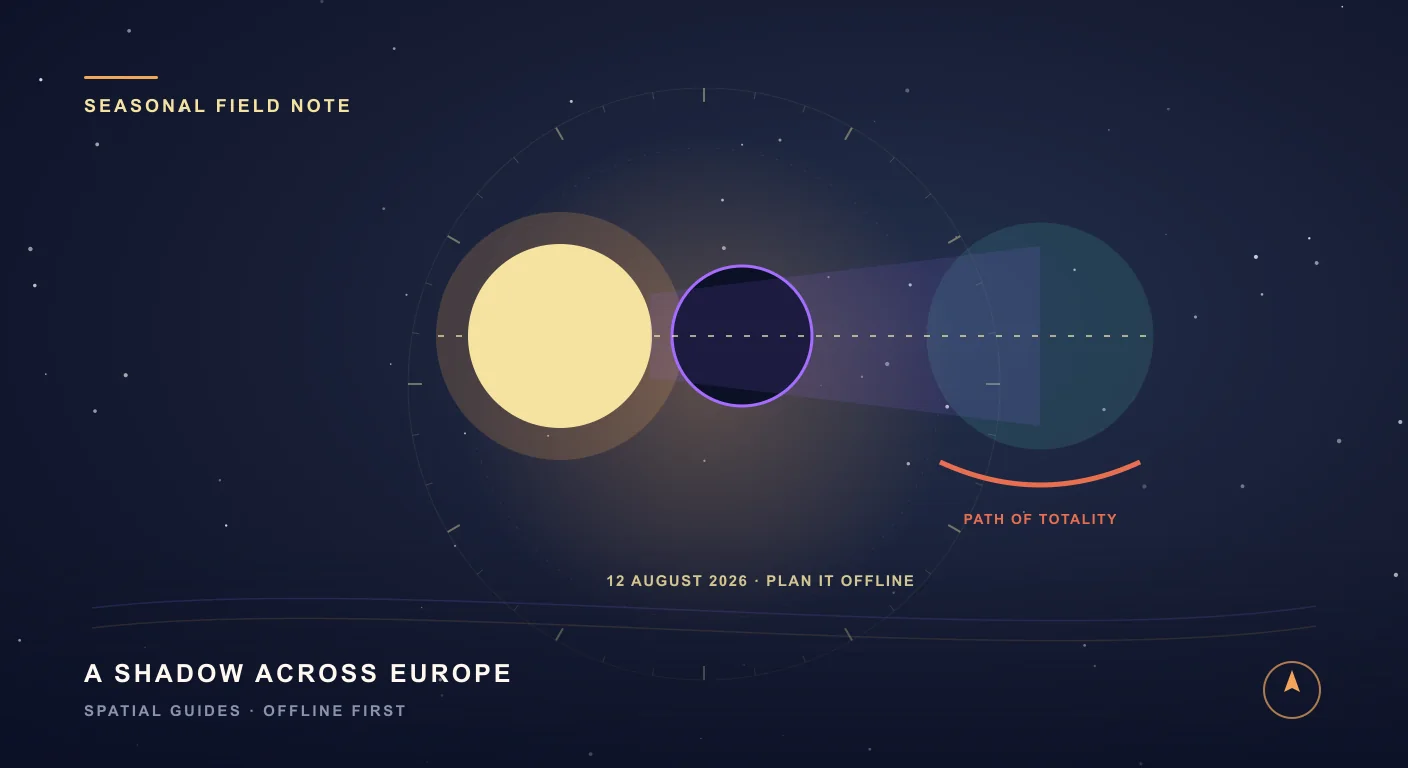
A total eclipse is coming back — mark August 12, 2026
Total solar eclipses are the most spectacular thing the sky ever does, and they are rare from any one place — a given spot on Earth waits centuries between them. On Wednesday, August 12, 2026, the Moon will slip exactly in front of the Sun and drag a ribbon of shadow from the high Arctic down to northern Spain. It is the first total solar eclipse to touch mainland Europe since 1999, and the first over Spain in more than a century.
What actually happens on the day
A solar eclipse can only happen at new moon, the one moment each month the Moon sits on the same side of us as the Sun. Usually it passes a little above or below and nothing happens. Once in a while the line is perfect: the Moon covers the Sun completely, the sky drops into twilight, the temperature falls, birds go quiet, and the Sun's pearly corona blazes out around a black disc. That is totality, and on August 12 it lasts up to about two minutes and eighteen seconds near the middle of the path over the North Atlantic.
Where and how you experience it depends entirely on where you stand. Inside the narrow path you get the full show; by the time the shadow reaches northern Spain, the eclipsed Sun sits very low on the western horizon at sunset, which makes for a breathtaking photograph but demands a clear, flat view to the west. Everywhere else, you get a partial eclipse — the Moon takes a crescent-shaped bite out of the Sun without ever fully covering it.
Where the shadow lands
The Moon's umbra touches down at sunrise in the Russian Arctic, races across the Arctic Ocean, and clips eastern Greenland and western Iceland — where the eclipse climbs highest and totality runs longest — before crossing the Atlantic and making its final landfall over northern Spain as the Sun sets. The path is only about 290 kilometres wide, so being on the right side of a coastline can be the difference between totality and a deep partial.
You do not have to be in the path to be part of it. Most of Europe, a swathe of northern Africa, and the north-eastern edge of North America will catch a partial eclipse, with coverage deepening the closer you are to the centre line. A 70% partial with the right filter is still a jaw-dropping sight — and a wonderful excuse to get outside and look up.
You don't need a data plan — SIMT works it out on your phone
The genuinely hard question is not is there an eclipse? — it is what will it look like from exactly where I will be, and at what time? SIMT answers that on the device, with no connection at all. It runs the same professional ephemeris models the observatories use, so the numbers are the same whether you have five bars or none. Open the Sun and its sky details show the next eclipse — its type and the time it peaks — right alongside the live azimuth, elevation, and the rise and set times for your day.
Want to see it coming? Open the Orrery, SIMT's interactive solar system, and scrub the time slider to August 12, 2026. In the Earth-centred view you can watch the Sun, Earth, and Moon slide into a single line, and the Moon Phases screen renders the event itself. It is the clearest way to understand why the eclipse happens — and to rehearse the timing before the day arrives.
Keep reading The Orrery is a time machine for the whole solar system — here is how to scrub through eclipses and rare alignments with it.What Did the Sky Look Like the Night You Were Born? Time-Travel the Solar System with SIMT's Orrery Ever wondered exactly where the planets were the night you were born, or where they will be during the next total eclipse? SIMT's Orrery puts the whole solar system in your hand and lets you drag time backward and forward to find out, entirely offline.Which way to look, down to the degree
Knowing when is only half of it; SIMT also tells you exactly where. The Sun's live azimuth is the compass bearing to turn to, and its elevation is how high to look. Follow the compass to that bearing, or simply raise your phone and let Iris, the augmented-reality view, paint the Sun straight onto your camera feed. If the marker is ever a hair off, tap the Sun to calibrate the alignment and it snaps precisely onto it — in both heading and tilt.
This matters most for the sunset totality over Spain, where the Sun will hang only a few degrees above the horizon. Days ahead, check the Sun's azimuth and elevation for the peak time in SIMT, then use the compass to scout a viewpoint with a clean, unobstructed view in that direction. Turn up on the day already knowing which rooftop, ridge, or stretch of coast to stand on.
Keep reading That AR view is Iris — and it pins the Sun onto your camera with no ARCore at all. Here is the math that makes it work.Iris: AR on Any Phone, Powered by Math Instead of ARCore Most AR apps lean on ARCore and a certified device list. Iris takes a smarter route: it paints any target onto your live camera with pure mathematics, so augmented reality runs on almost any phone, works offline, and barely touches the battery.A bonus after dark: the Perseids peak the same night
Here is the lucky part. Because a solar eclipse always falls on a new moon, the night of August 12–13, 2026 is completely moonless — and that happens to be the peak of the Perseid meteor shower, one of the best of the year. In most years a bright Moon drowns the fainter meteors; in 2026 the sky is as dark as it gets, so a good site could show dozens of shooting stars an hour. An eclipse by day and a meteor storm by night, on the same date.
SIMT is just as useful once the Sun is down. Use the compass to face away from town lights and toward the darkest horizon, tap up planets and bright stars to get your bearings while your eyes adapt, and keep the screen on its dim red night mode so you never lose your dark adaptation. Meteors can appear anywhere, but tracing them back points you to the shower's radiant in Perseus.
Keep reading SIMT's sky tools go well beyond one night — here is the full offline astronomy toolkit for planets, the Moon, and satellites.Offline Astronomy App for Planets, Moon Phases, Satellites, and Sky Tracking Most astronomy apps depend on a constant internet connection. SIMT calculates planetary positions, Moon phases, satellite passes, and celestial targets entirely on device, so the sky tools keep working even when you are off the grid.How to be ready on August 12
A little preparation turns a date on the calendar into a memory you keep for life. Here is the short routine:
- Install SIMT now — it is free, works offline, and needs no account.
- Open the Sun and note the eclipse peak time, plus the partial start and end for your location.
- Check the Sun's azimuth and elevation around the peak, then use the compass to scout a spot with a clear view in that direction — especially important for the low sunset view in Spain.
- Get certified eclipse glasses (ISO 12312-2) for everyone, and a solar filter for any camera or binoculars.
- On the day, use the compass or Iris AR to lock onto the Sun as first contact begins.
- Stay out after dark for the Perseids — SIMT will help you find the darkest direction and the radiant.
Get SIMT — free on Google PlayYour offline companion for the August 12, 2026 total solar eclipse and the Perseids that follow: exact times, the direction to look, and a live AR view — no internet required.The sky doesn't need a signal, and neither should you. SIMT computes the eclipse from wherever you're standing — then points you straight at it.
Always view the Sun through certified solar filters during all partial phases. Eclipse times and coverage vary by location — confirm your own local circumstances before you travel.
Questions answered in this guide
When is the next total solar eclipse?
The next total solar eclipse is on August 12, 2026. Its path of totality runs from the Arctic across eastern Greenland, western Iceland, and northern Spain, where it happens low in the west at sunset. If you miss it, the following total solar eclipse is on August 2, 2027, crossing North Africa with a much longer totality.
Where can I see the August 12, 2026 total solar eclipse?
Totality is visible only inside a narrow path about 290 km wide that crosses the Arctic Ocean, eastern Greenland, western Iceland, and northern Spain. Outside that path, a partial eclipse is visible across most of Europe, northern Africa, and north-eastern North America, with the Sun more deeply covered the closer you are to the centre line.
How long will totality last?
Up to about two minutes and eighteen seconds near the middle of the path over the North Atlantic. It is shorter toward the ends of the track, and in northern Spain totality is brief and very low on the horizon because it coincides with sunset.
Do I need internet to use SIMT for the eclipse?
No. SIMT computes eclipse times, the Sun's live azimuth and elevation, and rise-and-set entirely on your device using professional ephemeris models. It works exactly the same with full signal, weak signal, or no signal at all — ideal for the remote coasts and ridges where eclipses are often best seen.
How do I know which direction to look during the eclipse?
Open the Sun in SIMT for its live azimuth (the compass bearing to face) and elevation (how high to look). Follow the compass to that bearing, or raise your phone and use the Iris AR view to see the Sun marked on your camera feed. For the sunset totality in Spain, the Sun sits only a few degrees above the western horizon, so scout a spot with a clear view that way in advance.
Is it safe to look at a solar eclipse?
Only through proper protection. Use certified ISO 12312-2 eclipse glasses or a solar filter for all partial phases, and never look at the Sun through unfiltered cameras, binoculars, or telescopes. The naked eye is safe only during the brief total phase and only if you are inside the path of totality; put your glasses back on the instant the Sun's edge reappears.
Can I watch the Perseid meteor shower the same night?
Yes, and 2026 is an excellent year for it. Because the eclipse falls on a new moon, the night of August 12–13 is moonless, so there is no moonlight to wash out the Perseid peak. Find a dark site, let your eyes adapt for 20 minutes, and use SIMT to face away from light and get your bearings while you wait.
More from SIMT Blog
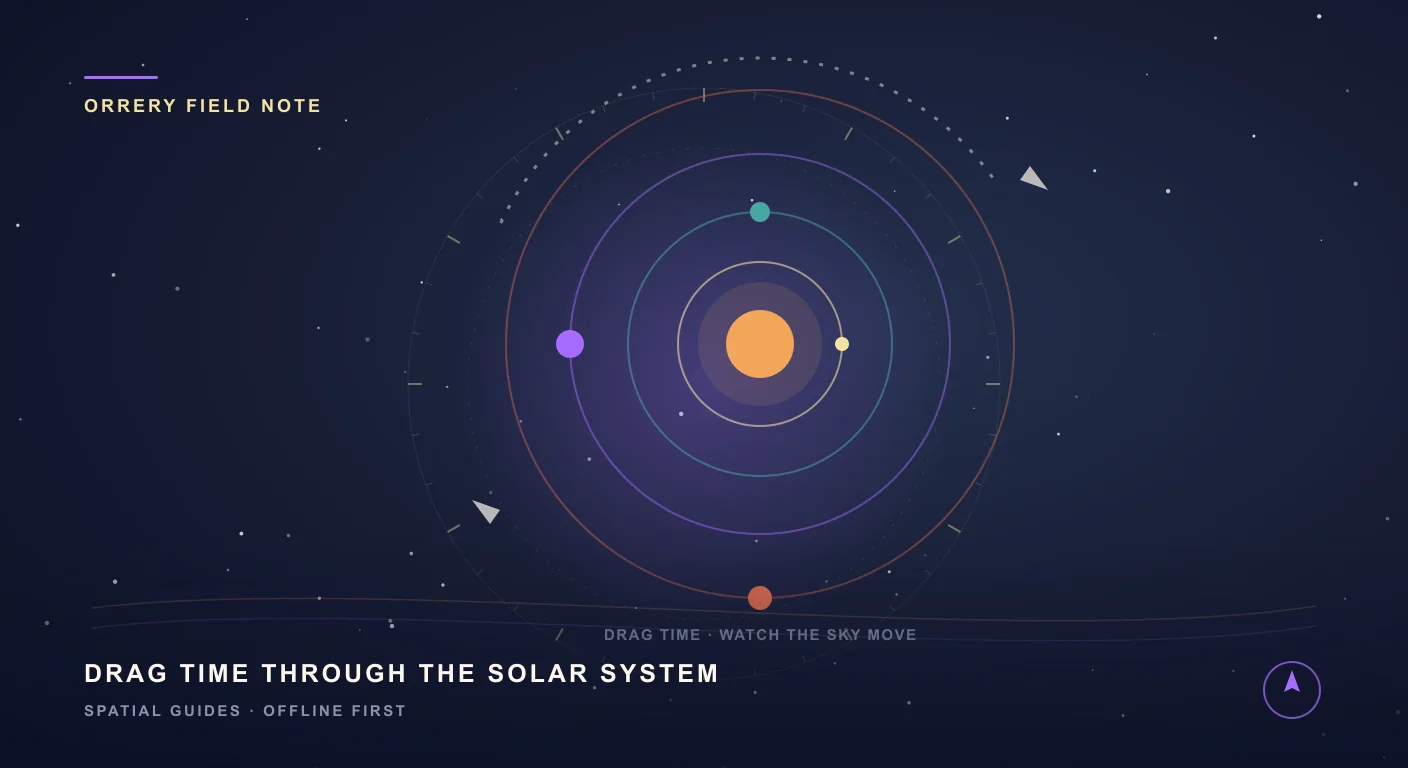
Orrery and time travel
What Did the Sky Look Like the Night You Were Born? Time-Travel the Solar System with SIMT's Orrery
Ever wondered exactly where the planets were the night you were born, or where they will be during the next total eclipse? SIMT's Orrery puts the whole solar system in your hand and lets you drag time backward and forward to find out, entirely offline.
Astronomy guide
Offline Astronomy App for Planets, Moon Phases, Satellites, and Sky Tracking
Most astronomy apps depend on a constant internet connection. SIMT calculates planetary positions, Moon phases, satellite passes, and celestial targets entirely on device, so the sky tools keep working even when you are off the grid.