
You already speak the language of the stars
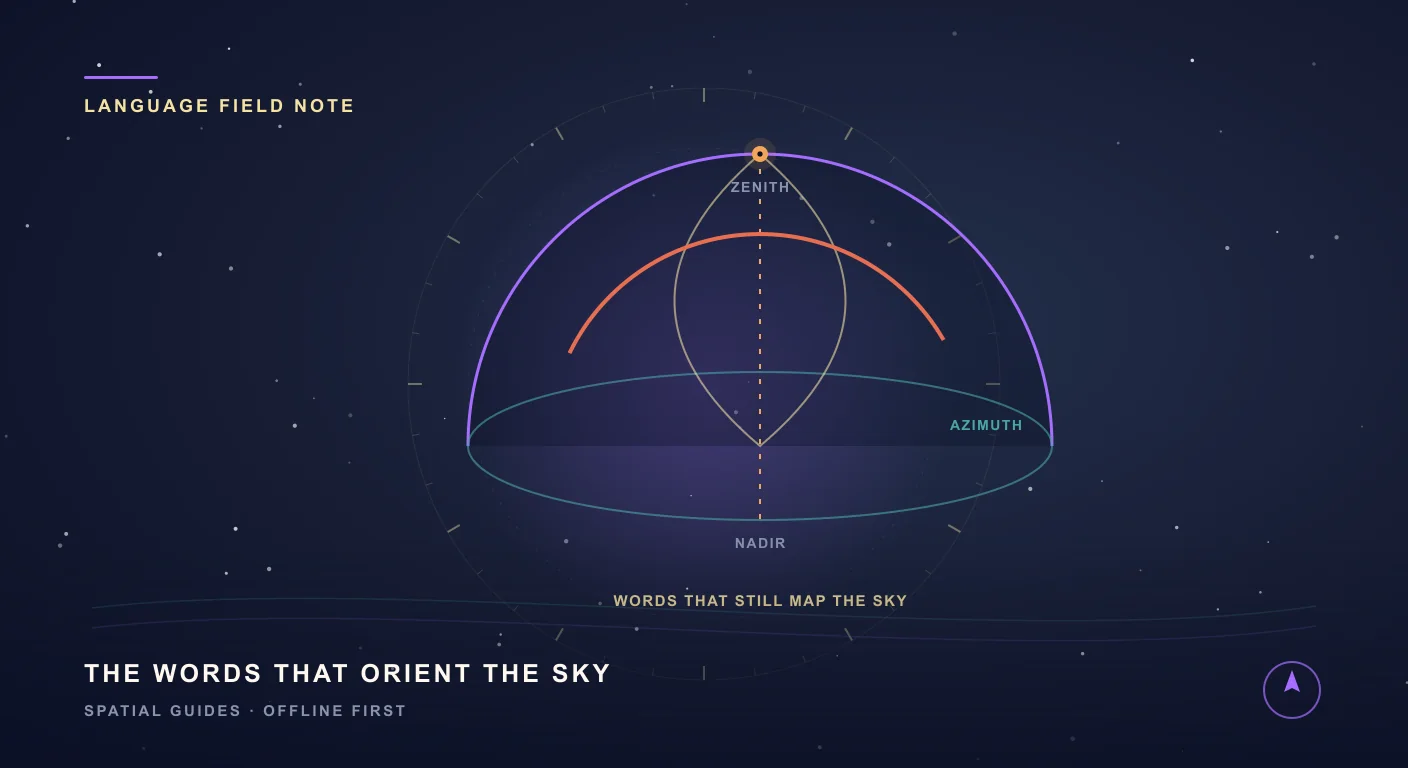
Picture this. You are standing in an open field at night. Straight above you, impossibly high, is a single point — the spot the sky would touch if it reached down to tap you on the head. Directly beneath your feet, on the far side of the planet, is its mirror twin. And all around you, ringing the horizon, runs an invisible circle you can measure in degrees: zero at north, ninety at east.
You have just located the zenith, the nadir, and your azimuth — three of the most fundamental ideas in all of navigation and astronomy. And here is the part almost nobody knows: every one of those words is Arabic. Two of them are, astonishingly, the same Arabic word.
This is the story of how a single word — سَمْت, samt — left the observatories of medieval Baghdad, rode the brass curves of an astrolabe across the Mediterranean, survived a scribe’s slip of the pen in a Latin monastery, and ended up on the compass screen in your pocket.
Three words, one sky
Let us define them, because the precision is its own kind of poetry:
- Azimuth — the horizontal direction to something, measured as an angle around the horizon. A compass bearing. Due west is an azimuth of 270°.
- Zenith — the point directly above you. The Sun reaches its zenith at local noon.
- Nadir — the point directly below you, hidden by the entire mass of the Earth.
Together they form a complete coordinate system for the heavens: the azimuth tells you which way to turn, and the up-and-down axis from zenith to nadir anchors everything else. Every star map, every telescope mount, every aircraft attitude indicator speaks this language.
The word at the heart of it: samt
In classical Arabic, سَمْت(samt) means a direction, a path, a way — the line you travel along. The astronomers of the 8th and 9th centuries, who inherited Greek astronomy and then vastly expanded it, used the word constantly. Three of its forms came down to us:
- To name a compass direction, they spoke of السَّمْت(as-samt) — literally “the direction.” In Arabic the article al- softens to as- before an s-sound, which is why it is as-samt, not al-samt. Its plural, as-sumut, became Old Spanish açumut, then Latin azimut — our azimuth.
- To name the point overhead, they said سَمْت الرأس(samt al-ra’s) — “the direction of the head.” Medieval Latin scribes shortened and mangled it; somewhere a copyist misread the Arabic m as the letters ni, and samt drifted into senit, then cenith, then zenith.
- And the point below? They called it نظير السَّمْت(nazir as-samt) — “the counterpart of the samt,” the zenith’s opposite. The word nazir (“counterpart, opposite”) reached us as nadir.
Azimuth and zenith are, at heart, the same Arabic word — samt — one sent along the horizon, the other sent straight up.
How a word travels 5,000 miles and 400 years
None of this happened by accident. It happened because of one of history’s great relay races of knowledge. Greek astronomy — above all Ptolemy’s monumental star catalogue — was preserved, corrected, and dramatically advanced in the Arabic-speaking world. In 9th-century Baghdad, scholars at the House of Wisdom translated the Greek works and pushed far beyond them. Even Ptolemy’s great book reached us under an Arabic name: we still call it the Almagest, from المجسطي(al-majisti).
Their favourite instrument was the astrolabe — a breathtaking brass computer of the heavens that could tell the time, find your latitude, locate the stars, and point the way to prayer, all by aligning sightlines against engraved scales. Even its parts carry Arabic names: the alidade, the rotating sighting bar, comes from al-ʿidada.
From Baghdad the knowledge flowed west into al-Andalus (Muslim Spain), and in the 12th century the translators of Toledo rendered it all into Latin for a hungry Europe. The Arabic words came along for the ride — and they never left.
Once you start noticing, the borrowed words are everywhere: algebra (al-jabr), algorithm (from the mathematician al-Khwarizmi), almanac, alchemy, alkali, alcohol — and even cipher and zero, both from sifr. Science still speaks with an Arabic accent.
Look up: the night sky is signed in Arabic
And it is not only the coordinates. It is the stars themselves. Look at Orion. Its shoulder is Betelgeuse — from يد الجوزاء(yad al-jawza), “the hand of the giant.” Its foot is Rigel — رِجل(rijl), “the leg.”
Across the rest of the sky you will find Aldebaran (al-dabaran, “the follower”), Altair (al-nasr al-ta’ir, “the flying eagle”), Vega (al-nasr al-waqi, “the swooping eagle”), Deneb (dhanab, “the tail”), and the demon star Algol (al-ghul — the very word that gave us ghoul). Hundreds of the proper star names we use today were handed down from Arabic catalogues.
Naming the invisible
Here is what moves us about all this. A direction is not a thing. You cannot hold an azimuth; you cannot put the zenith in a box. They are pure abstractions — and yet they are utterly real, and our entire civilisation of maps, ships, satellites, and smartphones rests on our ability to name and measure them.
For more than a thousand years, the word humanity reached for was samt. It outlasted empires, crossed languages, and survived the slow erosion of time — because the need it answers never goes away. Which way?
Meet samt, reborn
We loved this word so much that we named our app after it. SIMT — from سَمْت, the original word for direction — carries the whole tradition into your pocket. It is a compass and sky-navigator that, like the astrolabe, needs nothing but the sky:
- A precision compass you can calibrate against the Sun and Moon themselves — the astrolabe’s trick, rebuilt on a phone.
- More than 1,100 built-in targets — landmarks, sacred sites, and astronomical bodies — with live bearing, distance, and elevation.
- A live, animated solar system plus star and satellite tracking, so you can point your phone at any planet or the ISS.
- It all works fully offline, because the math runs on your device.
Questions answered in this guide
Is the word azimuth really Arabic?
Yes. Azimuth comes from the Arabic as-sumut, the plural of as-samt (the direction), which passed through Old Spanish and medieval Latin into English. It entered European science largely through Arabic treatises on the astrolabe.
What does samt mean in Arabic?
Samt means a direction, path, or way — the line along which you travel or look. It is the root behind both azimuth and zenith, and it is also where the SIMT app gets its name.
Are zenith and nadir also Arabic?
Yes. Zenith comes from samt al-ra’s, the direction of the head (the point overhead), garbled by a medieval scribe. Nadir comes from nazir as-samt, the counterpart or opposite of the zenith — the point directly below you.
Why are so many star names Arabic?
During the Islamic Golden Age, astronomers catalogued and named the stars in Arabic while advancing Greek astronomy. When those works were translated into Latin, the names came with them. Betelgeuse, Rigel, Aldebaran, Vega, Altair, Deneb, and Algol are just a few examples.
What is SIMT?
SIMT is a free, offline-first compass and sky-navigation app for Android and Wear OS, named after the Arabic word samt (direction). It offers Sun and Moon compass calibration, 1,100+ targets, a live solar system, and satellite tracking — all working without an internet connection.
More from SIMT Blog
Small screen. Big adventures.
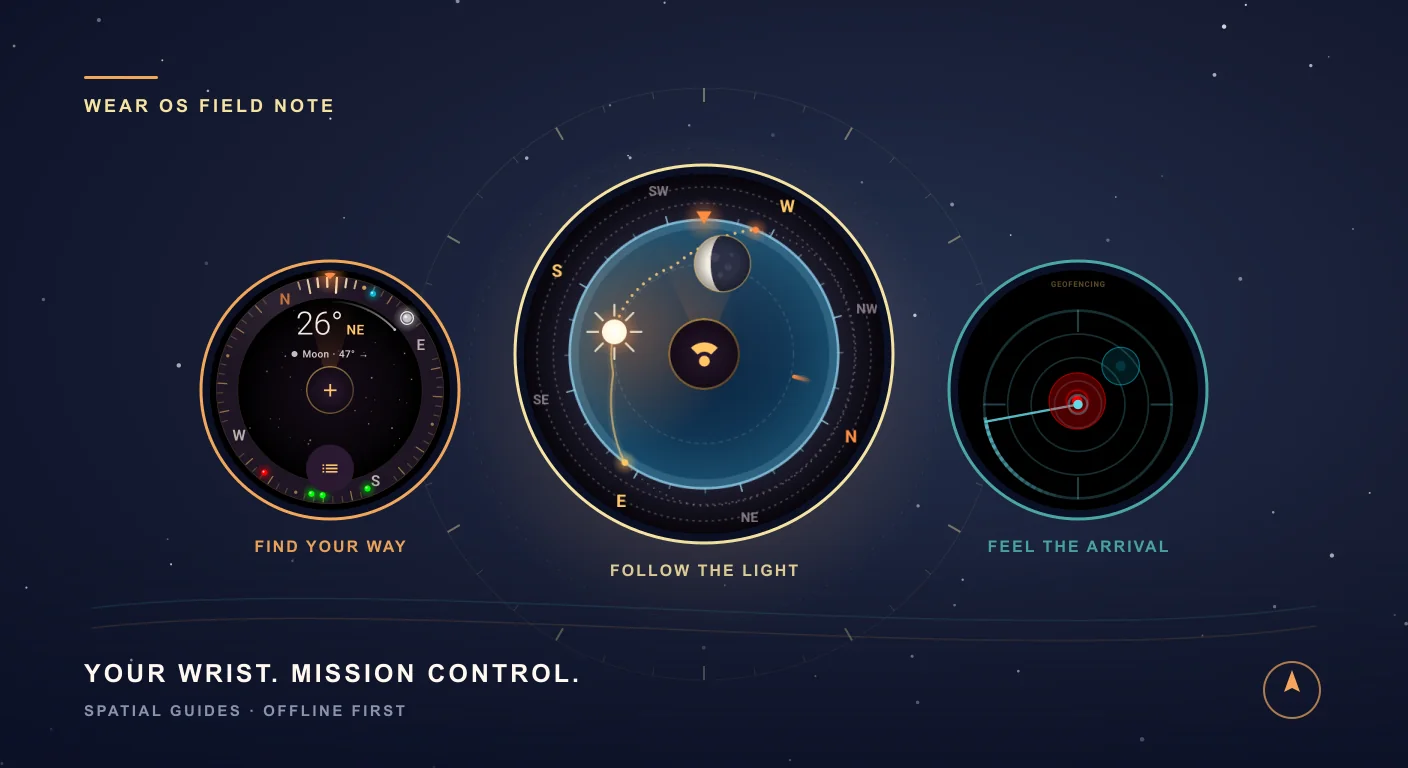
Your Wrist Just Became Mission Control: Meet SIMT for Wear OS
Find the way back. Follow the last light. Feel the moment you cross a boundary. SIMT brings a target compass, a living Sun and Moon dial, geofence alerts and a gravity-powered level to the screen already on your wrist.

Total solar eclipse 2027
The August 2, 2027 Total Solar Eclipse: The Great North African Eclipse, One Year Out
On August 2, 2027, the longest total solar eclipse visible from land this century sweeps across southern Spain and all of North Africa — Morocco, Algeria, Tunisia, Libya, Egypt — before crossing Arabia. It lasts up to 6 minutes 23 seconds, and nothing longer touches land until 2114. The eclipse is a year away: the perfect time to plan it, and SIMT does the planning offline.